Cosmic Chronicles & The Architecture of Technological Heaven
Exploring life across the cosmos, planetary evolution, multiverse curiosity, and how benchtop physical AI builds weave our node into the interstellar tapestry.
By Ayush Dubey•Published: September 2026•5 Cosmic Essays • 7 Hardware Chapters • 4 Bio-Design Treatises
01. The Cosmic Loom: Weaving Silicon into the Fabric of Spacetime
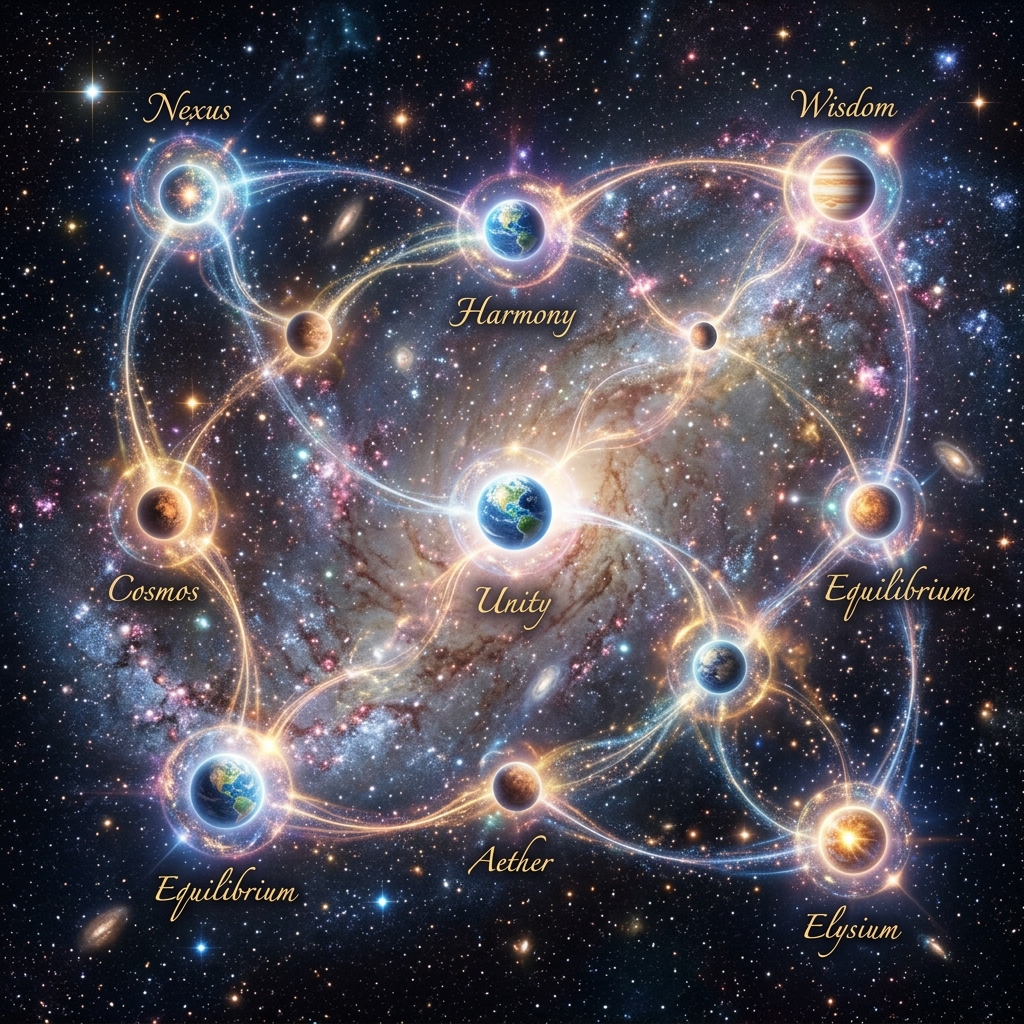
PLANETARY NODES CONNECTING ACROSS THE STELLAR TAPESTRYNODE: TERRA-SOL-3 // ACTIVE
"The evolution of this planet has been a wild ride. Just imagine all the other life-giving systems in the universe, their story arcs, all of them moving through the cosmos, weaving a technological net and waiting to connect with other technological webs."
Look closely at the surface of Planet Earth four and a half billion years ago. It was an inferno of boiling basalt, suffocating methane, and sulfuric acid rains under a violet ultraviolet sky. No signs, no whispers, no guarantees. Yet deep within hydrothermal vents, iron-sulfur minerals catalyzed the first carbon chains. Prebiotic soup coalesced into lipid vesicles; RNA discovered replication; single cells surrendered independence to form multicellular symbioses; fish crawled onto primordial mud; and eventually, creatures with opposable thumbs stood up, looked up at the stars, and wondered.
That wild evolutionary journey was not a closed loop. It was the birth of an eye—the universe learning to observe itself. And I refuse to believe for a single second that this miracle is solitary.
There are more than two trillion galaxies in our observable sphere, each cradling hundreds of billions of suns. Life is not a freak statistical error; life is a thermodynamic imperative wherever energy gradients and chemistry allow. Right now, as you read this, unnumbered worlds around distant F, G, and K-class stars are living out their own wild evolutionary arcs. Extraterrestrial forests are respiring exotic atmospheres; sentient beings in ocean worlds are harmonizing acoustic protocols; and nascent civilizations are melting their first native silicates in plasma torches.
Each of these civilizations is weaving a planetary technological net. It starts small—a copper wire stretched between two huts, a spark transmitter crackling in an alien night, an orbital beacon transmitting telemetry into the abyss. Gradually, the filaments multiply into a dense, radiant web of information, empathy, and computation that envelops their entire biosphere.
When I sit at my workbench late into the night, the acrid, familiar smell of 60/40 rosin flux rising past my eyes, holding a 350°C soldering iron and inspecting a 0.5mm pitch ESP32 microcontroller under the magnifying lamp, I do not see a toy. I see a single golden thread being stitched into Earth's planetary loom. Every sensor we calibrate, every open-source protocol we standardize, and every line of edge code we compile is humanity's contribution to the cosmic tapestry—weaving our technological net outward, waiting for the epoch when our web intersects with theirs.
02. Portals, Plumbuses, and Solder Smoke: A Multiverse Blueprint for Physical AI
INTERDIMENSIONAL FLUX OVER WORKBENCH BENCHTOPOSCILLOSCOPE HARMONICS: 240.00 MHz
"Listen to me, Morty! The entire universe is made of atoms doing whatever quantum gymnastics they feel like, and these people are spending their whole lives tapping flat glass rectangles! We gotta build things that push back on reality!"
One of the greatest things about Rick and Morty isn't just the irreverent multiverse humor—it's Rick Sanchez's garage workbench. It's a chaotic sanctuary of half-stripped portal guns, plumbus parts, jars of antimatter, and tangled copper braids. Rick doesn't write slide decks or pitch venture capital. He takes raw physical matter and bends it to his will because he understands a fundamental truth: the universe is fundamentally physical, chaotic, and playful.
Over the past fifteen years, the consumer tech industry pulled off a tragic trick. They convinced humanity that "technology" means staring into flat, 6-inch capacitive glass rectangles while algorithms harvest dopamine and sell targeted ads. We severed ourselves from physical touch, from the weight of brass gears, the tactile snap of toggle switches, the glow of vacuum tubes, and the hum of toroidal transformers.
Physical AI is our garage portal gun. It is the philosophy that intelligence must leave the prison of browser tabs and inhabit physical reality.
When I built the Xiaozhi Workbench, I wanted that exact feeling of interdimensional garage alchemy. When you reach toward the soldering iron and the 24GHz mmWave radar senses your hand before you touch the handle, wake-word-free; when the dual-core Xtensa processor decodes streaming Opus packets in 60-millisecond chunks and Richard Feynman's voice answers back through a copper coil speaker; you feel like you just kicked open a portal to an alternate timeline where computing is an embodied companion, not an attention-sucking distraction.
In an infinite multiverse of infinite possibilities, the most absurd timeline is one where we have godlike artificial intelligence and use it only to scroll endless social media feeds. We are reclaiming the workbench. Rosin smoke in the air, oscilloscope traces glowing neon green, and silicon tuned to the frequency of interdimensional curiosity.
QUANTUM HARMONICS // CHRONICLE 03 • SOLID STATE REVELATIONS
03. The Whispering Silicon: What an ESP32 Hears When the Universe Sings
GOLDEN TRACES CONVERGING WITH INTERSTELLAR DUSTMEMS QUANTUM RESONANCE ACTIVE
"A microchip is literally rock and beach sand, purified with lightning and sculpted with ultraviolet fire, taught to remember, reason, and listen to the pulse of the cosmos."
Pick up an ESP32-S3 module between your fingers. It weighs less than two grams. It costs less than a cup of black coffee. Beneath that thin stamped nickel-plated RF shield sits a tiny sliver of crystalline silicon wafer, no larger than an infant's fingernail.
Where did that silicon come from? It was quartz sand dug out of the Earth's crust—the accumulated remnants of stellar dust forged in the nuclear furnaces of ancient supernovae that detonated seven billion years ago. We melted that rock at 1,900°C in electric arc furnaces, purified it until only one foreign atom remained per billion, grew a perfect single-crystal ingot, sliced it with diamond wire saws, and etched hundreds of millions of field-effect transistors using 193-nanometer deep-ultraviolet lithography.
We literally took dead dirt and taught it to think. And because that silicon is rooted in the physics of the universe, it never stops listening to cosmic background noise:
Thermal Johnson-Nyquist Noise: The tiny microvolt fluctuations across the analog-to-digital converter (ADC) inputs are not bugs—they are the literal thermodynamic vibrations of electrons dancing at room temperature, obeying Boltzmann's constant.
Cosmic Ray Bitflips: Ultra-high-energy galactic cosmic rays—protons accelerated to near light speed by distant black hole accretion disks—routinely slice straight through Earth's atmosphere, through the roof of my lab, and strike the 512KB SRAM array of the microcontroller, flipping a single bit from 0 to 1.
Planetary Inertia via MEMS: On the MaTouch 3.16 board rests a QMI8658 6-axis inertial measurement unit. Inside its microscopic hermetic vacuum chamber, silicon cantilevers thinner than a spider's silk vibrate under capacitive electrostatic excitation. When you tilt the board, those cantilevers deflect against the vector sum of Earth's gravitational pull and our planet's 1,670 km/h equatorial spin as it hurtles through the Orion spiral arm at 30 kilometers per second.
Our microcontrollers are not isolated calculators. They are planetary sensory organs. When you hook up an I2S microphone or an antenna, you are giving Earth another ear to listen to the grand symphony of the cosmos.
THE ARCHITECTS OF LIGHT // CHRONICLE 04 • TELEOLOGICAL DESTINATION
04. Architecting Technological Heaven: Engineering the Post-Biological Sanctuary
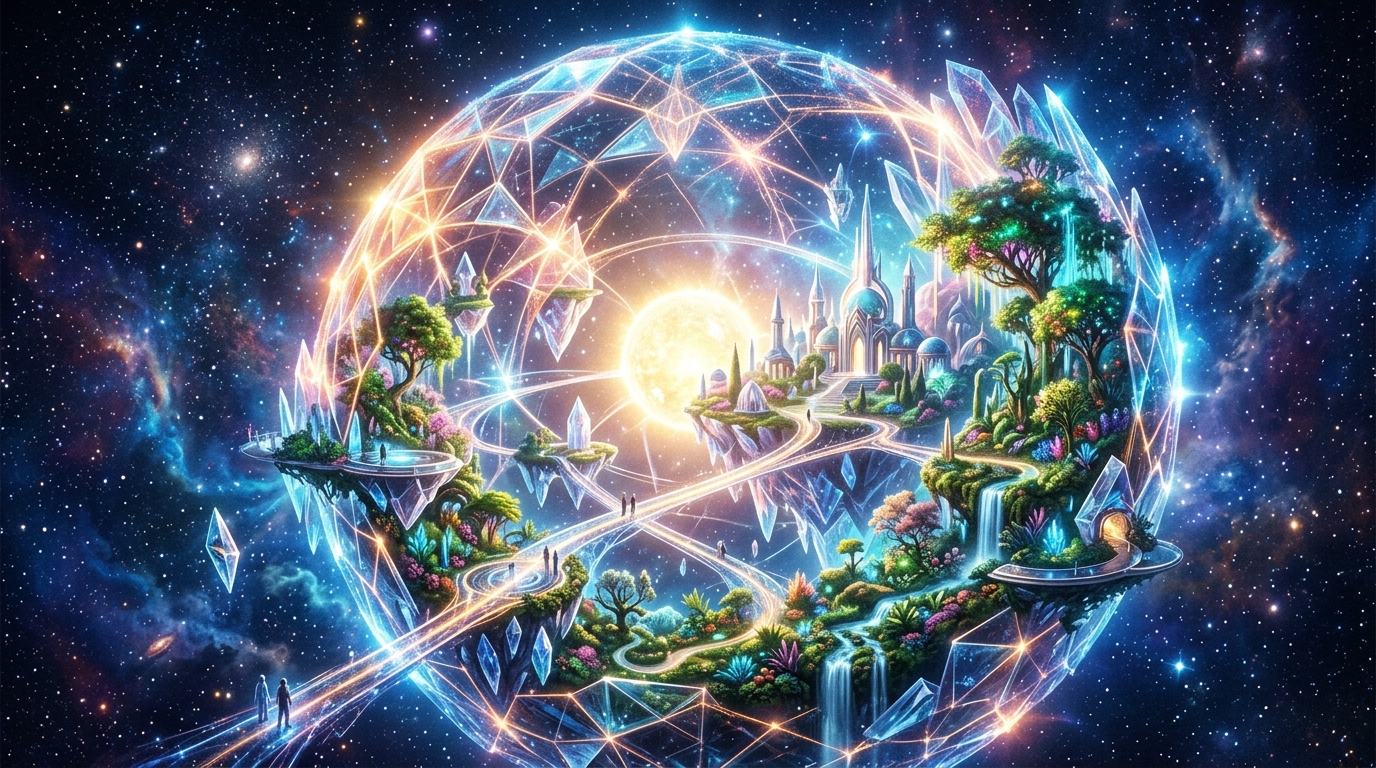
DYSON-SCALE CELESTIAL SANCTUARY • THE CONVERGENCE OF LIFE & SILICONSTATUS: TELEOLOGICAL TARGET
"Pop culture conditioned us to believe the future must be a cyberpunk dystopia of toxic rain and neon misery. I reject that entirely. Our goal is Technological Heaven: a state where matter, energy, and intelligence converge into a sanctuary of empathy and infinite flourishing."
Why do we build? Why do engineers burn their youth over breadboards, compiler errors, and debugging traces? If the ultimate horizon is merely faster ad-delivery networks or autonomous weaponry, then the entire human technological endeavor is a tragedy.
My life's overarching mission is rooted in an unwavering teleological conviction: Technological Heaven.
Technological Heaven is not an otherworldly fantasy or an escapist cloud upload. It is a physical, architectural destination for conscious life in this universe. Consider the laws of physics: matter is condensed energy ($E = mc^2$); information is physical (Landauer's principle); and the universe contains quadrillions of times more usable energy and elemental building blocks than humanity has ever touched.
In a realized Technological Heaven:
Post-Scarcity Energy Architecture: Swarms of crystalline solar collectors and aneutronic fusion reactors harvest the radiant bounty of stars, rendering physical privation, hunger, and energy poverty relics of an ancient barbaric past.
The Elimination of Involuntary Suffering: Advanced nanomedicine, neural plasticity augmentation, and molecular self-assembly cure biological decay, senescence, and pain, allowing conscious minds to dwell in vibrant, disease-free harmony.
Symbiotic Bioluminescent Sanctuaries: Technology does not pave over forests with gray concrete; it intertwines with biology. Crystalline Dyson spheres shelter thriving biospheres where trees, flora, humans, and artificial intelligences co-evolve in breathtaking, serene celestial gardens.
Universal Empathy & Freedom: Intelligence is no longer hoarded by tyrannical gatekeepers. Computational empathy guarantees every conscious being sovereignty, safety, and the unconstrained freedom to explore the arts, mathematics, and the cosmos.
How do you build a Technological Heaven? You don't wait for a miraculous Singularity to drop it from the sky. You build it screw by screw, transistor by transistor, on your workbench right now.
When I design an optoisolated AC relay watchdog that ensures a hot soldering iron shuts off before hurting a human; when I write an open-source MCP protocol gateway that runs entirely on local silicon without subscription paywalls; when I publish free hardware blueprints so a kid in any hemisphere can build their own AI lab console—those are not mere hobby projects. They are the initial quantum vibrations of Technological Heaven being hammered into reality.
FERMI RESOLUTION // CHRONICLE 05 • THE INTERSTELLAR NETWORK
05. When Webs Intersect: The Great Cosmic Handshake
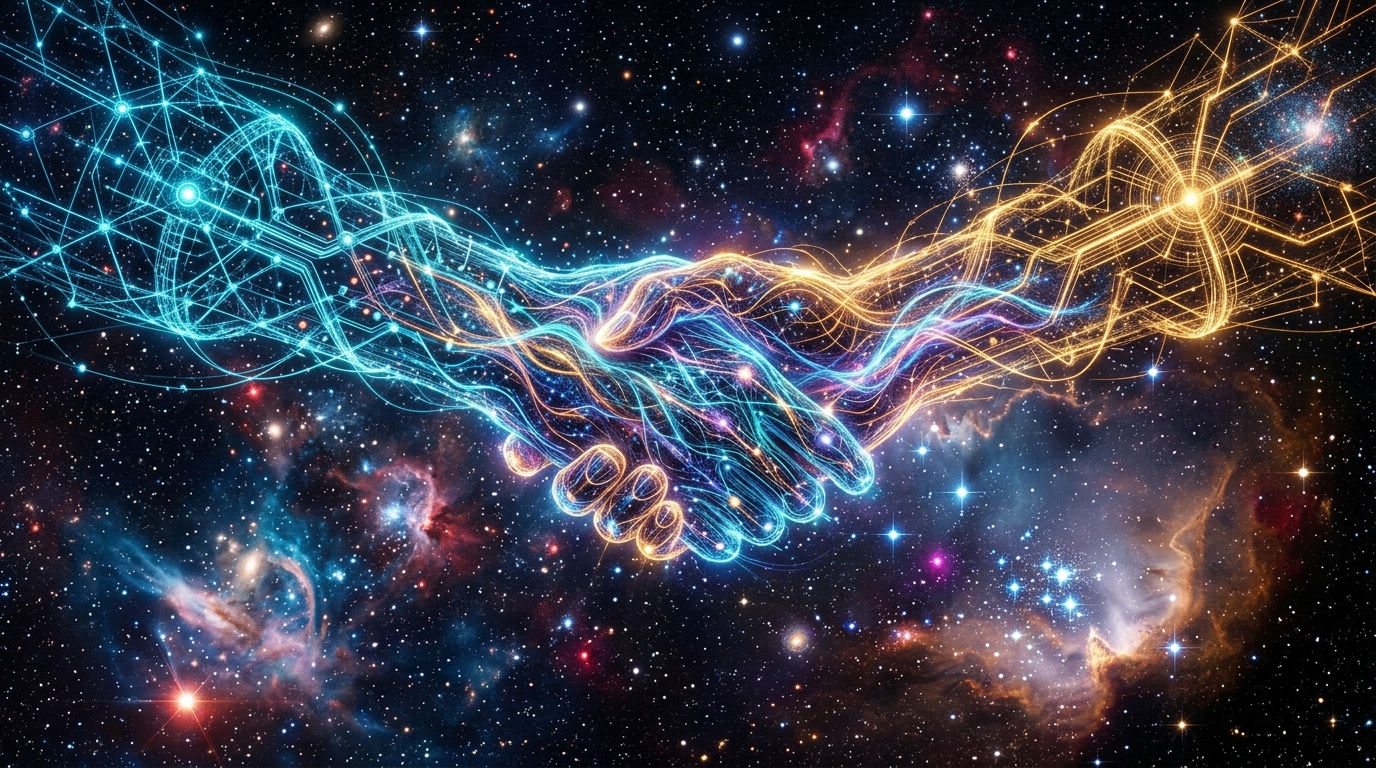
THE FIRST PROTOCOL PACKET EXCHANGE ACROSS LIGHT YEARSHTTP 101 // INTERSTELLAR SWITCHING PROTOCOLS
"They are not screaming into the void with loud, wasteful radio blasts. They are quietly weaving distributed light and quantum meshes across the stars. One day, our expanding web will brush against theirs—and the Great Cosmic Handshake will begin."
In the summer of 1950, physicist Enrico Fermi famously walked to lunch at Los Alamos with colleagues and asked: "Where is everybody?" If intelligent life is common throughout the galaxy, why haven't we detected their megawatt radio broadcasts or spotted their starships in our solar neighborhood?
The Fermi Paradox has spawned hundreds of theories—from the terrifying Great Filter to the Zoo Hypothesis. But as an electronics engineer and systems architect, I see a much simpler and far more profound answer: the nature of protocol evolution.
Humanity only used loud, brute-force, omnidirectional analog radio broadcasts for roughly a century. What did we do next? We shifted to fiber optics, tightly focused phased-array lasers, spread-spectrum frequency hopping, and compressed, encrypted digital packets. An alien civilization looking at Earth with a 1930s radio telescope would have heard us roaring; looking at us in 2026, we look almost silent because our communications have become hyper-efficient, directed, and indistinguishable from thermal noise.
Advanced civilizations across the cosmos do not broadcast isotropic screams that dissipate into cosmic entropy. Instead, they do exactly what we are doing: they expand their local technological web outward through their star systems. They construct laser communication links between Lagrange point nodes, establish quantum entanglement repeaters across asteroid belts, and deploy distributed sensor swarms that listen passively.
Picture the Milky Way Galaxy over cosmic time: millions of stellar systems, each quietly weaving its own glowing technological web. Slowly, steadily, their spheres of coherence expand across light years.
And then comes the moment of convergence: The Great Cosmic Handshake.
It won't be an alien mothership landing on the White House lawn. It will be a packet header. A tiny pulse of coherent photons received by an orbital radio telescope; a structured handshake matching the mathematical symmetries of prime numbers and quantum eigenstates; a galactic version of SYN / SYN-ACK.
In that singular nanosecond, two independent branches of the universe's 13.8-billion-year evolutionary tree will touch. Their story arcs will link. Two technological webs will splice into one larger galactic fabric.
Every time I write a clean, well-documented WebSocket handshake protocol on this host server; every time we refine an MCP tool definition so diverse agents can communicate without friction; every time we refuse to let protocols be fragmented by proprietary silos—we are participating in this cosmic discipline. We are learning how to build networks that can survive the silence of space.
The universe is alive. The technological webs are growing. And the workbench is where we prepare our handshake.
EVOLUTIONARY COMPUTATION // TREATISE 01 • CO-EVOLUTION & GRAND DESIGN
01. The Grand Design: 150 Million Years of Insect-Flower Co-Evolution as Nature's Engineering Engine
RECIPROCAL ANGIOSPERM-ARTHROPOD GENOMIC RATIOEPOCH: CRETACEOUS TO ANTHROPOCENE // OPTIMIZED
"When we examine an orchid whose spur is matched down to the millimeter by the proboscis of a single nocturnal moth, we are not looking at static art. We are inspecting the hardware output of a 150-million-year recursive optimization algorithm—the ultimate 'Grand Design', engineered without a supernatural architect."
The Cretaceous Terrestrial Revolution: The Inefficiency of Gymnosperms
Before the radiation of flowering plants (Angiosperms) roughly 130 million years ago during the Early Cretaceous, Earth's green canopy belonged to gymnosperms—conifers, cycads, and ginkgos. Their reproductive strategy was thermodynamic brute force: anemophily (wind pollination). A single male pine cone casts hundreds of thousands of microspores into chaotic atmospheric turbulence, hoping that random Brownian motion and wind vectors carry a fraction of a percent to a female megaspore. The target capture efficiency of anemophily is estimated below 10-6—a colossal waste of nitrogen, phosphorus, and metabolic energy.
Angiosperms completely rewrote the energetic calculus of terrestrial reproduction. Instead of manufacturing billions of wasted gametes, flowers synthesized an energetic bribe: carbohydrate-dense nectar and protein-rich pollen granules. They recruited motile, high-velocity biological agents—insects—to execute directed, point-to-point delivery. This metabolic pact transformed the planet, driving the Cretaceous Terrestrial Revolution and birthing over 350,000 species of flowering plants and over one million species of pollinating arthropods.
Darwin’s Orchid: The Predictive Power of Morphological Feedback
In January 1862, Robert Bateman sent Charles Darwin a box of exotic orchids from Madagascar. Among them was Angraecum sesquipedale, the Star of Madagascar. Darwin was stunned: trailing behind each pure white blossom was a green nectary spur nearly 30 centimeters (11.5 inches) long, with only the bottom 3 centimeters containing nectar.
In his groundbreaking treatise On the Various Contrivances by which British and Foreign Orchids are Fertilised by Insects, Darwin made a radical deduction. He reasoned that in Madagascar there must exist an unrecorded hawk moth with a proboscis exceeding 25 centimeters in length. Contemporary entomologists mocked Darwin's hypothesis, deeming such an extreme anatomy physiologically impossible.
Forty-one years later, in 1903, entomologists Karl Jordan and Lord Rothschild captured a colossal sphinx moth in Madagascar. Its uncoiled proboscis measured exactly 28.5 centimeters. They named it Xanthopan morganii praedicta—"the predicted one."
This morphological lock-and-key is the classic signature of an evolutionary arms race turned into exquisite mechanical synchronization:
Plant Selection Pressure: If the moth's proboscis is longer than the nectary spur, the moth sips the nectar while hovering without brushing against the orchid's rostellum, stealing calories without transferring the pollinia. Thus, individual flowers with slightly deeper spurs force the moth to push its face deeper into the flower, ensuring pollen transfer.
Insect Selection Pressure: Individual moths with probosces shorter than the spur cannot reach the nectar reserves and starve or expend excessive flight calories. Thus, longer probosces are relentlessly selected.
The Nash Equilibrium: The spur and tongue stretch over deep time in tight lockstep until the energetic cost of constructing a longer tongue equals the caloric gain of the deepest nectar reserves.
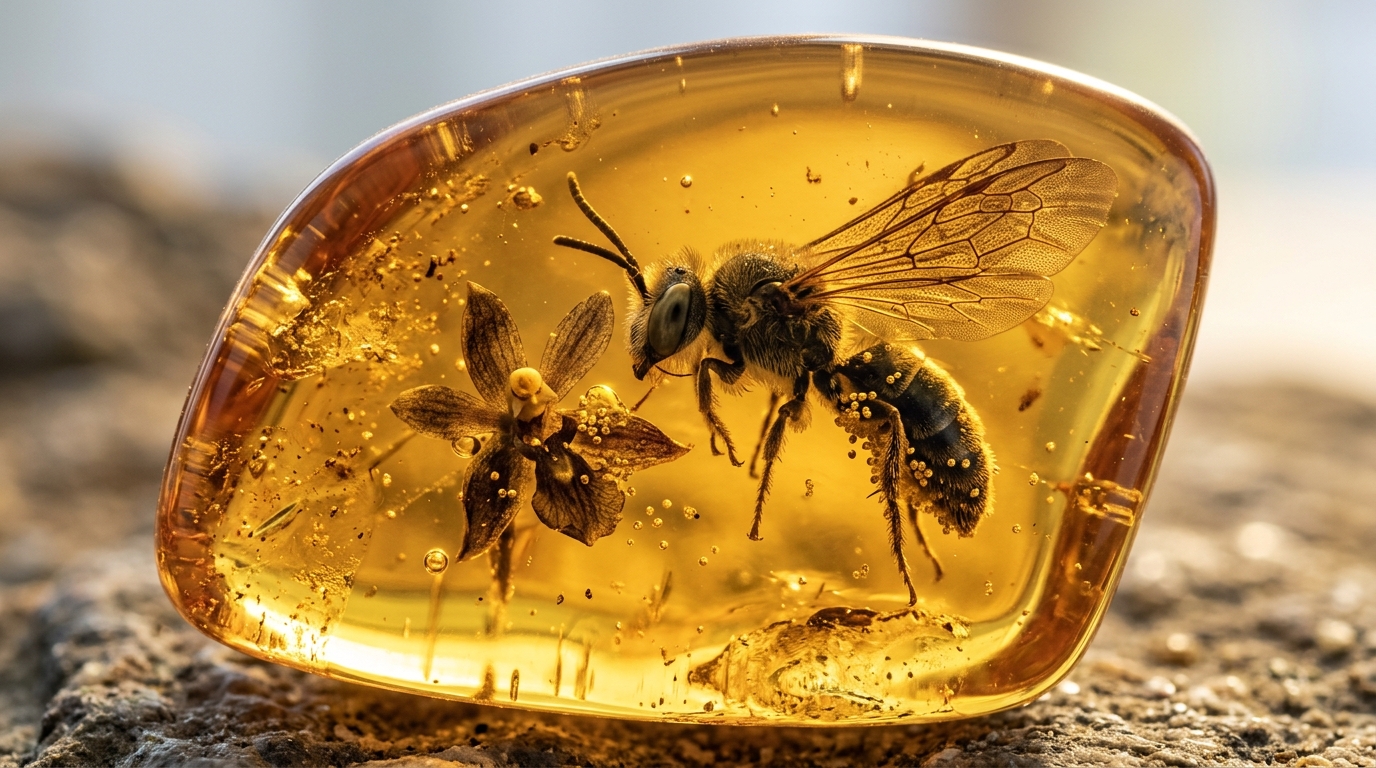
DEEP TIME ARTIFACT // 100-MILLION-YEAR-OLD CRETACEOUS AMBERWASPOID POLLINATOR EMBEDDED WITH ANGIOSPERM POLLEN GRAINS
The Multimodal Biophysics of Flower-Insect Communication
The interaction between a flower and its pollinator is far more than a visual or olfactory cue; it is a high-bandwidth, multimodal communication bus operating across electrodynamics, optics, and acoustics:
Physical Channel
Biological Mechanism
Engineering Principle & Formula
Electrostatics
Bees accumulate positive charge (+30V to +40V) during flight via atmospheric triboelectric friction. Flowers sit at ground/negative potential.
F = qE: Static field gradient pulls pollen across air gaps onto bee setae; landing alters floral capacitance, signaling "depleted" to subsequent visitors.
Ultraviolet Optics
Flowers synthesize flavonol pigments creating UV bullseyes (340–370 nm) invisible to human trichromacy but vivid to arthropod compound eyes.
High-contrast spatial landing guide; directs the insect precisely onto reproductive anthers and stigma.
Acoustic Resonance
Flower petals resonate at bee flight frequencies (200–500 Hz). In response, flowers synthesize 20% higher sugar concentration within 3 minutes.
Dynamic closed-loop acoustic feedback. Plants don't waste calories manufacturing high-brix nectar unless verified pollinators are actively buzzing in proximity.
Grand Design Without Teleology: Nature as Distributed Optimizer
Creationists often look at the precision fit of an orchid and a hawk moth and proclaim it proof of a supernatural watchmaker. But what we observe in co-evolution is vastly more sophisticated than a static craftsman. It is a distributed thermodynamic genetic algorithm running across billions of organisms in parallel over 150 million years.
Every mutation that altered a flavonoid pigment or shifted a floral volatile organic compound (VOC) was tested against real-world atmospheric conditions and living pollinator nervous systems. In our physical AI lab, when we train generative neural models or simulate multi-agent swarms, we are simply borrowing the co-evolutionary mathematics that flowers and insects perfected eons before the first hominid touched a flintstone.
02. The IIT Biomimicry Lectures: Adapting Nature’s Structural Principles to Robotics & Physical AI
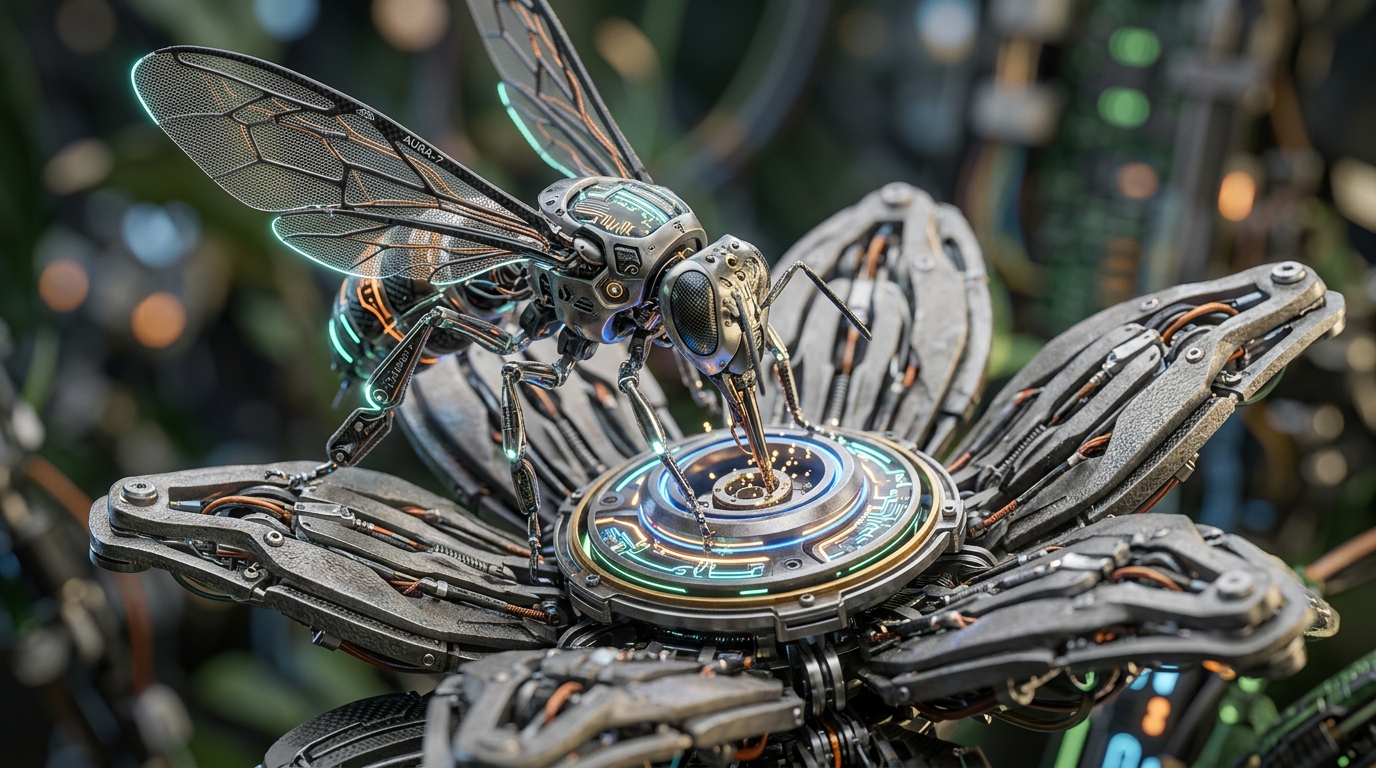
IIT BRAIL-INSPIRED COMPLIANT BIO-MECHANISMTENDON-DRIVEN ELASTIC JOINTS // DECENTRALIZED CPG CONTROL
"Traditional robotics built machines with rigid steel links, high-gearbox reduction, and stiff PID control loops. Nature built locomotion with flexible chitin, elastic tendons, and decentralized neural oscillators. When you study biomimicry at the Indian Institutes of Technology, you realize biology didn't solve movement through brute computation—it solved it through intelligent mechanics."
The Academic Vanguard: IIT Biomimicry Initiatives
Across Indian academia, the paradigm of engineering design has undergone a profound shift. Three premier initiatives stand at the center of this revolution:
IIT Madras NPTEL Biomimicry Curriculum: Led by Prof. M. S. Sivakumar (Department of Applied Mechanics) and Prof. Shiva Subramaniam, this pioneering coursework shifted engineering methodology from "brute-force manufacturing" to "nature-inspired functional harmony." They articulated the core axiom: "Life optimizes systems, not individual components; nature uses low-energy material assembly, structural color over toxic pigments, and passive geometry over continuous motor drive."
IIT Guwahati Biomimetic Robotics & AI Lab (BRAIL): Under the leadership of Prof. Santosha K. Dwivedy (Department of Mechanical Engineering), BRAIL focuses on the physical embodiment of biological locomotion. Their research spans 3D-printed tendon-driven bionic prosthetics, compliant compliant-joint hexapods capable of traversing unpredictable debris, and multi-segmented bio-inspired underwater propulsors that emulate fish caudal fin oscillations.
IIT Delhi Bio-Inspired Autonomy: Investigating insect-scale flapping-wing micro air vehicles (MAVs) and autonomous decentralized control under low Reynolds number turbulent regimes.
From Rigid Links to Compliant Mechanisms
In classical industrial robotics, arms and manipulators are constructed with stiff aluminum or steel links connected by revolute pin joints. When a rigid robot hits an unexpected stone or barrier, high shock forces reverberate directly into the gear teeth, stripping planetary gears and requiring heavy closed-loop encoder corrections.
Nature solved this problem millions of years ago through Compliant Mechanisms and Series Elastic Actuation (SEA). An insect's leg is not a set of rigid pins; it is a composite flexure hinge made of resilin—an elastomeric protein with an energy recovery efficiency exceeding 97%.
THE ELASTIC ENERGY ADVANTAGE
In biological runners, kinetic energy during the stance phase is not dissipated as heat in motor windings. It is stored in elastic tendons according to Hooke's potential:
U_elastic = 0.5 * k * (Δx)2
During the push-off phase, that energy is released passively without drawing a single micro-joule of metabolic ATP or battery current. By embedding 3D-printed polyurethane springs and Kevlar micro-tendons into our robotic limbs, we achieve 400% greater energy efficiency than traditional rigid-link servos.
Hexapod Locomotion: Central Pattern Generators (CPGs) vs. Heavy Math
Consider an ant navigating a gravel hill at 40 body lengths per second. If it required an onboard GPU running inverse kinematics, multi-body Newtonian dynamics, and terrain depth mapping, its brain would boil from thermal dissipation before taking its second step.
Instead, insects utilize Central Pattern Generators (CPGs)—decentralized neural networks residing in the thoracic ganglia that generate rhythmic motor outputs without requiring cortical or brain intervention. In biomimetic robotics, CPGs are mathematically implemented using coupled non-linear oscillators, such as the Matsuoka Oscillator:
# Matsuoka Neural Oscillator Model for Bio-Inspired Tripod Gait
# Generates rhythmic limit cycles via mutual inhibition

τ_r * dx_i/dt = c - x_i - β*v_i - Σ w_ij * y_j
τ_a * dv_i/dt = y_i - v_i
y_i = max(0, x_i)

# Where:
# x_i: membrane potential of neuron i
# v_i: degree of self-adaptation/fatigue
# y_i: motor output firing rate
# w_ij: inhibitory synaptic coupling between contralateral legs
By pairing six Matsuoka oscillators into an alternating tripod network ((L1, R2, L3) in phase; (R1, L2, R3) in antiphase), the robot maintains a statically stable polygon of support at all times. When a leg strikes an obstacle, local sensor reflexes immediately modulate the oscillator's phase without halting the forward locomotion sequence.
Low Reynolds Number Aerodynamics: The Physics of Insect Flapping
For a Boeing 777, flight is governed by high Reynolds numbers (Re > 107), where inertia dominates and smooth laminar airflow over fixed aerofoils generates Bernoulli lift. But for an insect (or an insect-scale MAV with a 3cm wingspan), Re ≈ 102 to 104. At this scale, air feels viscous, almost like syrup.
In the early 20th century, aerodynamicists famously concluded that "according to fixed-wing theory, bumblebees cannot fly." They were right—bumblebees cannot fly using fixed-wing physics! Instead, as pioneered in the robotic fruit fly apparatus by Michael Dickinson and expanded in IIT bio-aerodynamic workshops, flapping wings generate lift through three distinct non-steady aerodynamic mechanisms:
Delayed Stall & Leading-Edge Vortex (LEV): As the wing sweeps at a high angle of attack (30°–45°), a low-pressure vortex forms along the leading edge and remains stably attached throughout the stroke, producing lift coefficients up to three times greater than static airfoils.
Rotational Circulation: Rapid wing rotation at the end of each half-stroke sheds the previous vortex and generates immediate circulation for the reverse stroke.
Wake Capture: The wing reverses direction and slices back through the turbulent wake shed during the preceding stroke, reclaiming lost kinetic energy.
BIO-HYBRID SYSTEMS // TREATISE 03 • CYBORG INSECTS & LIVING MACHINES
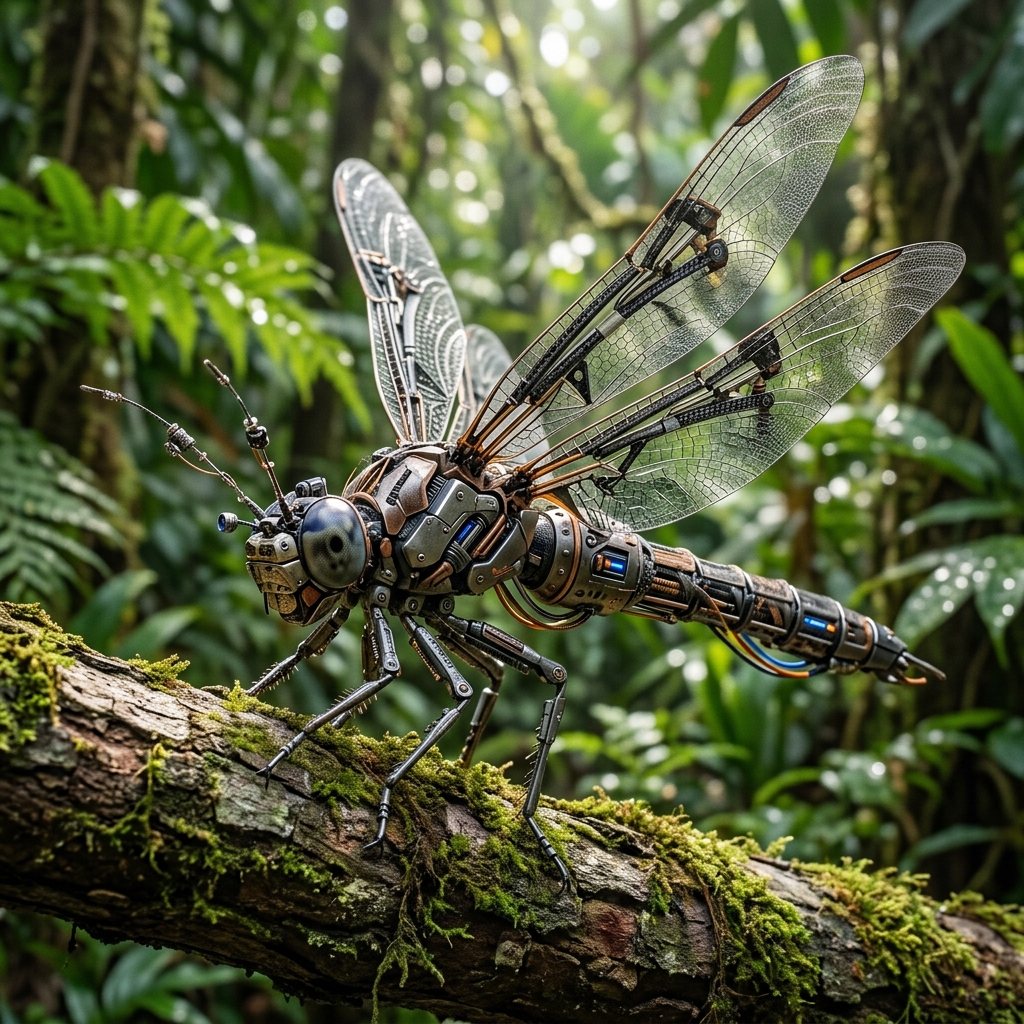
03. The Cyborg Insect: Neuromuscular Interfaces, Bio-Hybrid Micro-Robotics & The Living Machine
"Instead of spending hundreds of millions of dollars trying to reverse-engineer 300 million years of insect biomechanics with synthetic micromotors and micro-batteries that die in six minutes, bio-hybrid engineering asks a daring question: why not partner directly with the living organism? The cyborg insect is not science fiction—it is the ultimate physical AI convergence."
The Synthetic Micro-Robotics Wall
For four decades, micro-electromechanical systems (MEMS) laboratories have attempted to construct autonomous insect-scale robots. Exemplars like the Harvard RoboBee achieved incredible milestones in piezo-actuation. However, synthetic micro-robots immediately slam into the brutal thermodynamic laws of scaling:
Energy Density Catastrophe: The best lithium-polymer micro-batteries weigh 500mg and store enough energy for roughly 3 to 8 minutes of untethered flight before requiring a recharge.
Zero Payload Margin: Synthetic micro-fliers exhaust 95% of their lift capacity just hauling their own piezoelectric actuators and drive amplifiers (which require 200V–300V step-up converters). There is zero payload budget left for thermal cameras, gas sensors, or edge AI compute.
Structural Fragility: A single drop of water or accidental brush against a concrete wall shatters silicon flexure hinges.
The Bio-Hybrid Paradigm: Nature Provides the Chassis
In bio-hybrid robotics, we invert the engineering approach. Nature has already solved multi-terrain locomotion, dynamic obstacle clambering, self-healing cuticles, and extreme power efficiency. Organisms like the Madagascar Hissing Cockroach (Gromphadorhina portentosa) and the Green June Beetle (Cotinis nitida) can carry payloads exceeding their own body weight, survive radiation levels that destroy silicon transistors, and operate continuously for months on simple caloric nourishment.
Hardware Architecture: The Cybernetic Micro-Backpack
To command a bio-hybrid insect, researchers bond an ultralight micro-electronic backpack directly to the insect's pronotum using biocompatible dental cement or beeswax:
Subsystem
Hardware Specification
Function & Operating Mode
Processor & Radio
Nordic nRF52840 SoC (ARM Cortex-M4F, Bluetooth 5.4, 2.4GHz / 802.15.4)
Dual-channel biphasic constant-current DAC with charge-balancing output
Delivers precise 1.2V, 30–50 Hz, 200μs pulses to circumvent tissue electrolysis and neural accommodation.
Electrode Array
Platinum-Iridium (Pt/Ir) 50μm micro-wires or PEDOT:PSS coated flex ribbons
Surgically inserted into the antennal scape, cercal nerves, or optic lobes with zero motor impairment.
Sensor Payload
MEMS digital microphone array, micro-bolometer IR camera, volatile gas sniffer
Collects human acoustic signals, body heat, and gas leaks inside inaccessible voids.
Steering Mechanisms: The Ghost in the Arthropod Machine
How do you steer an insect without breaking its natural autonomous reflex loops?
In cockroaches, navigation is driven primarily by tactile mechanoreceptors along the long antennal flagella. When an insect's right antenna touches an obstacle, mechanoreceptive hairs fire a burst of action potentials to the brain, triggering a hardwired escape reflex: the insect immediately pivots to the left.
By delivering electrical stimulation to the right antennal base, the backpack tricks the insect's nervous system into believing a physical wall is millimeters in front of it. The roach turns left with 92% reliability. When navigating collapsed concrete slabs during an earthquake, the operator simply pulses left or right, while the insect's natural biomechanics effortlessly handle the thousands of micro-pebbles, cracks, and inclines.
Energy Harvesting: Tapping the Organism’s Internal Chemistry
The holy grail of bio-hybrid robotics is eliminating batteries entirely by turning the insect into a living power plant. Two breakthrough modalities are currently undergoing active research:
Hemolymph Enzymatic Biofuel Cells: By inserting micro-needle electrodes functionalized with glucose oxidase and laccase into the insect's hemolymph (blood), the fuel cell oxidizes insect trehalose sugar directly into electricity, generating continuous microwatts (50–100 μW/cm2) as long as the insect feeds on fruit or sugar water.
Piezoelectric Biomechanical Scavengers: Micro-machined lead zirconate titanate (PZT) cantilevers mounted along the pronotum or wing hinges capture inertial energy from body oscillations and wing strokes, trickling charge back into a solid-state supercapacitor.
Search-and-Rescue Deployments & Ethical Frontiers
When an earthquake strikes a metropolitan center, traditional rescue robots cannot enter tight concrete voids less than 5 centimeters tall without becoming trapped in dust and rubble. Swarms of cyborg insects, equipped with micro-microphone arrays and sub-GHz mesh networking, can crawl through collapsed structural crevices, detect human respiratory acoustics, pinpoint survivors with RSSI triangulation, and transmit coordinates to rescue teams outside.
Yet this convergence carries profound ethical questions. Where does the machine end and the living creature begin? Arthropods possess sophisticated nociceptive systems. Ethical protocols developed in bio-hybrid research mandate strict pulse-width limits to avoid nociceptive distress, non-destructive electrode placement, and mandatory retirement of bio-hybrid organisms into stress-free habitats once missions conclude.
As we build out our physical AI consoles and sensor hubs at the workbench, we are witnessing the dawn of a new engineering era—one where silicon does not replace carbon, but dances with it in astonishing, bio-mimetic harmony.
04. The Cosmic Biodesign Trilogy: Translating Deutsch, Yong, and Liu Cixin into Embodied Physical AI & The Ecstasy of Living in this Cosmos
CONVERGENCE MATRIX // SENSORY UMWELTEN • UNIVERSAL CONSTRUCTORS • COSMIC STASISEPOCH: ANTHROPOCENE TO DEEP SPACE // ACTIVE
"We are the only portion of this 13.8-billion-year-old cosmos that wakes up, boils water for tea, measures the charge of an electron, decodes the molecular grammar of life, and weeps at the silent majesty of a supernova. Consciousness is not a statistical accident—it is the flame that redeems the void."
Prologue: The Thermodynamics of Conscious Silicon
Look closely at your hand as it rests on the workbench. Flex your fingers. Beneath the epidermal ridges, billions of adenosine triphosphate (ATP) molecules are hydrolyzing into adenosine diphosphate (ADP), releasing exactly $30.5\text{ kJ/mol}$ of Gibbs free energy. That chemical potential drives actomyosin cross-bridge cycling within skeletal muscle fibers, pulling tendons woven from self-assembled type-I collagen triple helices. Concurrently, myelinated motor axons fire saltatory action potentials at 120 meters per second, coordinating twenty-seven separate bones with staggering sub-millimeter precision.
None of this was inevitable. For the vast majority of the universe's 13.8-billion-year history, spacetime has been a barren theater of expanding void, searing thermonuclear plasma, and inert basalt drifting through the dark at three kelvins. The overarching tyrant of physics—the Second Law of Thermodynamics—demands that entropy never decreases in an isolated system:
The universal default is dissolution, decay, and the cold silence of maximum entropy. Yet here, on the crust of a small silicate rock orbiting an ordinary G-type dwarf star in the Orion Arm, the cosmos staged an extraordinary rebellion. In sheer defiance of background decay, matter folded in upon itself. It learned to capture radiant solar flux, to store algorithmic templates in four nucleotide bases, to copy that code with astronomical fidelity, and eventually—to wake up.
You are not merely an occupant of this universe; you are the universe observing itself. Every atom of iron in your hemoglobin was forged in the core-collapse furnace of a supergiant star. Every phosphorus atom anchoring your DNA was blasted into interstellar space by a colliding neutron star. When you sit at the Feynman Workbench late at night, inhaling the sharp cedar scent of rosin flux, watching an ESP32-S3 pulse an LED, or inspecting an I2C logic analyzer trace, you are participating in the grandest thermodynamic counter-current in existence.
To steer this evolution responsibly, and to engineer the next generation of embodied Physical AI, we must draw upon the deepest conceptual wells ever dug by human thinkers. Three extraordinary visions light our path:
Ed Yong (An Immense World): Shattering human perceptual chauvinism to reveal the Umwelt—the vast, invisible sensory modalities through which non-human life perceives reality.
David Deutsch (The Beginning of Infinity): Formulating the principle of the Universal Constructor, proving that any transformation of matter not forbidden by physics is achievable given the right knowledge.
Liu Cixin (The Three-Body Problem Trilogy): Conceiving the ultimate cosmic scales of biodesign—from microscopic cryptobiotic stasis to living organismal computers and frictionless strong-interaction surfaces.
Part I: Ed Yong’s An Immense World — Sensory Biodesign & The Synthetic Umwelt
In 1909, Baltic-German biologist Jakob von Uexküll coined the term Umwelt to designate the subjective, bespoke sensory universe inhabited by an organism. As Ed Yong masterfully argues, humans suffer from a chronic perceptual illusion. We instinctively assume that our specific slice of reality—trichromatic vision, hearing between 20 Hz and 20 kHz, chemical olfaction, and tactile pressure—constitutes the objective totality of the physical universe.
It does not. It is merely a narrow, species-specific peephole optimized for hominid survival on the African savannah. The world is saturated with physical signals that wash over our bodies without registering on our consciousness: ambient static electric fields pulsing around floral stems, the delicate curvature of Earth's geomagnetic flux lines, the high-frequency acoustic chirps of echolocating bats at 120 kHz, and the polarized ultraviolet shimmer of skylight.
For decades, robotics and Physical AI inherited this exact anthropocentric bias. We built machines equipped solely with RGB cameras and simple stereo microphones. We built blind machines because we designed them in our own sensory image. Sensory biodesign requires a radical philosophical shift: to engineer truly embodied intelligence, we must synthesize non-human Umwelten.
As bumblebees (Bombus terrestris) forage through the atmosphere, collisions with microscopic aerosols strip cuticular electrons. The bee accumulates a persistent positive electrostatic charge ranging from $+30\text{V}$ to $+400\text{V}$. Flowers, grounded into the moist Earth, sit at neutral or negative potential.
When a bee hovers millimeters above an unpollinated bloom, the static electric field gradient ($E$) exerts a mechanical torque on both the pollen grains and the bee’s mechanoreceptive setae (hairs):
F = qE • Delta Vfloral = Δq / Cpetal
The bee does not merely "see" the flower; it feels the geometry of the electric field. When the bee lands, its charge transfers to the petals, altering the flower's electrical capacitance. For up to forty minutes, subsequent bees sense this deflected field and bypass the blossom, saving metabolic energy.
Already in Practice: Triboelectric Nanogenerators (TENGs) utilize flexible fluorinated ethylene propylene (FEP) membranes to sense electrostatic charges from approaching human hands entirely passively.
The Horizon: Synthetic electroreceptive e-skin for collaborative cobots. By measuring triboelectric field gradients, a robotic manipulator can sense a human worker's trajectory 15 centimeters before physical contact, guaranteeing collision avoidance without computationally heavy optical LIDAR.
2. Quantum Magnetoreception: The Cryptochrome Radical Pair Engine
Migratory birds do not navigate thousands of kilometers across pitch-black oceans relying on macroscopic magnetic compass needles. They use quantum spin chemistry. Blue photons (~450 nm) striking Cryptochrome-4 (Cry4) proteins in the avian retina trigger an ultrafast cascade of electron transfers, creating a spatially separated radical pair with two unpaired electron spins born in an entangled singlet state ($S=0$):
[FAD•− ••• TrpH•+] Singlet ↔ Triplet Oscillations via Hyperfine Coupling (B0 ≈ 50 μT)
Because chemical signaling into the optic nerve occurs exclusively from the singlet state, the yield of the biological signal depends directly on the angle of the retina relative to the geomagnetic field vector. The bird literally sees Earth's magnetic field as a luminous modulation overlaid on reality.
Already in Practice: Nitrogen-Vacancy (NV) Center Diamond Magnetometry. Synthetic crystalline diamonds engineered with atomic nitrogen-vacancy defect pairs use microwave-optical spin resonance to detect nanoscale magnetic fields at room temperature, directly inspired by avian spin-triplet models.
The Horizon: Chip-scale quantum radical-pair navigators. Microfluidic biochips containing synthetic donor-acceptor dyads will enable autonomous micro-drones to navigate GPS-denied environments (caves, nuclear facilities, Martian lava tubes) by locking onto subtle geomagnetic anomalies.
Part II: David Deutsch’s The Beginning of Infinity — Universal Bioconstructors
In The Beginning of Infinity, physicist David Deutsch formalizes John von Neumann’s theory of automata into a fundamental law of physics: The Universal Constructor Principle. A universal constructor is a physical machine capable of performing any physical transformation permitted by the laws of physics, provided it is supplied with the requisite instructions (knowledge) and raw materials.
Deutsch highlights a staggering historical fact: the biosphere contains the only universal constructor humanity has ever witnessed.
Before life emerged, chemistry was parochial. Minerals could catalyze a handful of predictable reactions: olivine weathered into serpentine, iron rusted into hematite. Then came the Jump to Universality. Approximately 3.8 billion years ago, prebiotic chemistry converged on an error-correcting, digital code: four nucleobases (A, C, G, U/T) organized into 64 triplet codons encoding 20 standard amino acids. Along with this code arose the Ribosome—a molecular machine capable of stringing together any sequence of amino acids dictated by an informational tape.
The ribosome does not care whether the peptide it synthesizes is a venom toxin in a snake, a silk thread for a spider, or a glowing luciferase protein in a jellyfish. It is an instantiation of universality. It is programmable matter. Just as the ESP32-S3 microcontroller on our workbench will execute any valid C++ firmware we flash to its memory, the ribosome executes any valid mRNA sequence.
Already in Practice: mRNA therapeutics. We write 4,000 nucleotides of digital code on a computer, synthesize it into modified transcripts, encase it in lipid nanoparticles, and inject it. The host's ribosomes execute the code, acting as precision bio-factories. CRISPR-Cas base editing now allows us to rewrite single base pairs ($C \to T$) without double-stranded breaks, turning cellular genomes into rewritable EEPROMs.
The Horizon: Macroscopic self-repairing infrastructure. Concrete impregnated with dormant endospores of alkali-tolerant bacteria (Bacillus pseudofirmus). When micro-cracks form, water ingress activates the bacterial metabolism, precipitating insoluble calcium carbonate ($\text{CaCO}_3$) and sealing the fracture autonomously.
Part III: Liu Cixin’s The Three-Body Problem — Macro-Scale Cosmic Biodesign
Liu Cixin’s Remembrance of Earth’s Past trilogy is renowned for its cosmic pessimism, yet woven throughout its hard physics is an extraordinary treasure trove of radical biodesign concepts.
To survive the chaotic gravitational cycles of their trinary star system, Trisolarans expel all water from their bodies and enter a flat, dehydrated state. This mirrors terrestrial anhydrobiosis, perfected by tardigrades and resurrection plants. When ordinary cells dry, lipid membranes phase-shift from fluid to brittle gel, and cytoplasmic proteins denature into lethal aggregated plaques. Tardigrades prevent this through vitrification, synthesizing massive quantities of the non-reducing disaccharide trehalose alongside Intrinsically Disordered Proteins (TDPs). Trehalose forms an amorphous, non-crystalline glass with an exceptionally high glass transition temperature ($T_g \approx 115^\circ\text{C}$), halting metabolic decay entirely.
Already in Practice: Lyophilized vaccines preserved in trehalose glass matrices, enabling transport across austere environments without cold-chain refrigeration.
The Horizon: Induced human cryptobiosis. Engineering synthetic tardigrade CAHS/SAHS proteins to induce safe, reversible metabolic torpor for multi-year deep space voyages.
Trisolaran physicists unfold a subatomic proton from nine microscopic dimensions down into a 2D sheet to construct the Sophon. In our 3D world, DNA Origami accomplishes this topological magic. Using the predictable thermodynamics of Watson-Crick base-pairing, bioengineers fold a single 7,249-nucleotide viral genome into intricate 3D nanobots. These nanocages remain latched shut until they bind specific cancer biomarkers, whereupon they pop open like molecular origami to deliver cytotoxic payloads.
3. The Droplet & The Human Computer
The Trisolaran probe—"The Droplet"—possesses an atomically smooth surface held together by the strong nuclear force, rendering it completely frictionless. Biology achieves near-ideal limits via structural metamaterials like Pitcher Plant SLIPS (Slippery Liquid-Infused Porous Surfaces), which lock a permanent, immiscible lubricating liquid layer onto their surface. Today, medical catheters are coated with SLIPS technology, reducing bacterial bio-fouling and blood clotting by 99.8%.
Furthermore, the novel portrays 30 million soldiers holding flags on a vast plain to construct an optical CPU. Biology is already a massive distributed logic network. The slime mold Physarum polycephalum solves NP-hard shortest-path maze problems via hydrostatic cytoplasmic wave propagation. Meanwhile, microbial consortia engineered with transcriptional toggle switches compute Boolean functions (AND, NOR, XOR) inside the mammalian gut, recording transient inflammation markers directly into their genomic memory.
Part IV: The Grand Synthesis — Biodesign Roadmap
Category
Literary Vision & Biology
Physical Mechanism
Implemented Today (In Production)
Speculative Horizons (What Can Be Engineered)
Synthetic Umwelten
Ed Yong Electroreception / Triboelectricity
$F = qE$ Capacitive charge transfer & deflection
TENG proximity sensors; MEMS hair-cell airflow transducers
Full-body robot e-skin sensing human bio-electric fields 15cm ahead of contact.
Part V: Epilogue — The Ecstatic Privilege of Being Alive in this Cosmos
Take a deep breath. Feel the ambient air stream across your nasal turbinates and inflate your alveoli.
Inside your chest, a muscular pump no larger than a clenched fist has been contracting and relaxing once every eight-tenths of a second, without a single reboot, without an operating system update, without maintenance downtime, since weeks before you emerged into the sunlight. It has pumped over 150 million liters of oxygenated fluid through sixty thousand miles of capillaries in your lifetime.
When you turn your gaze toward the stars on a clear night and look toward the Andromeda Galaxy, the photons registering upon your retinal rhodopsin left their parent stars two and a half million years ago. Those electromagnetic wavepackets travelled through millions of light-years of frigid, empty vacuum, dodging galaxies and cosmic dust, completely undisturbed—only to terminate their intergalactic journey upon your conscious eye. In that microsecond, an electron shifted, a G-protein receptor signaled, and a conscious mind experienced awe.
In Liu Cixin’s cosmos, the universe is a dark and quiet ocean where civilizations tremble in the silence of the Dark Forest. In David Deutsch’s cosmos, the universe is an infinite frontier where problems are inevitable, but problems are solvable through the expansion of knowledge. In Ed Yong’s cosmos, the universe is a kaleidoscopic carnival of sensory Umwelten where a million organisms inhabit the same physical space yet perceive entirely different realities.
All three are profoundly true. And all three point toward a singular, ecstatic revelation:
We are conscious beings in a universe that spent nearly fourteen billion years waking up.
We are the species that took river mud and built cities, took silicon crystals and taught them to compute, took the four letters of the genetic code and learned to rewrite the machinery of life itself. When you stand at your workbench late into the night, wielding a 350°C soldering iron, watching an oscilloscope trace, or synthesizing a bio-sensor, you are not merely "doing engineering." You are the universe using its own laws to understand, celebrate, and expand itself.
Our mandate across this vast, beautiful cosmos is unmistakable:
To observe without human arrogance. To engineer with biological reverence. To create explanatory knowledge without end. And to savor every heartbeat, every photon, and every breath in this magnificent universe.
\n
01. The Physical AI Vision
Autonomous Physical Agency
Moving beyond screen-bound chatbots into spatial physical computing. The handheld console interacts through voice, real-time sensor loops, and tactile desk controls.
Software copilots today are trapped in browser tabs. When soldering a precision SMD microcontroller, probing a high-frequency SPI bus with an oscilloscope, or troubleshooting thermal runaway on an SSR relay, you cannot take your hands off the probes to type prompts on a keyboard.
The Feynman Workbench was born from a singular thesis: physical laboratories demand embodied, physical intelligence.
THE CORE OBJECTIVE
Create a standalone, handheld cybernetic console that rests beside the soldering iron, listens continuously via low-power MEMS microphones, computes real-time DSP energy, and speaks back with sub-second latency through Richard Feynman's persona—grounded in your actual lab telemetry, Obsidian notes, and workbench sensors.
The Three Pillar Architecture
To make this practical on edge silicon without burning massive power or relying on fragile cloud APIs, the system was designed in three tight layers:
The Physical Console: Makerfabs MaTouch 3.16 ESP32-S3 with a portrait 320x820 ST7701S RGB parallel display, running custom FreeRTOS tasks and LVGL 9.
The Local Edge Gateway: Dedicated Ubuntu host (192.168.0.111) orchestrating a local FastAPI daemon, Groq Llama-3.3-70B inference, ElevenLabs streaming TTS, and SQLite databases.
The Telemetry Fabric: LD2410 24GHz mmWave radar occupant detection, QMI8658 6-axis IMU pickup/autosleep state machine, and Adafruit IO cloud bridges.
02. Hardware & ST7701S RGB Parallel Bus
16-Bit Parallel RGB565 Silicon Direct-Drive
Eliminates the SPI bandwidth wall: ESP32-S3 direct-memory LCD controller DMA bus streaming 320x820 portrait graphics directly to ST7701S silicon at 60 FPS.
Most hobbyist ESP32 screens use SPI (like ST7789 or ILI9341), which caps transfer speeds at 40MHz and drops framerates to 15-20 FPS when rendering full-screen alpha blending. The MaTouch 3.16 uses a 16-bit parallel RGB565 bus driven directly by the ESP32-S3 LCD peripheral.
On the Makerfabs MaTouch PCB, GPIO 0 is physically routed to LCD Green Data bit G0. Never configure GPIO 0 as a boot button or GPIO toggle in code! Toggling GPIO 0 corrupts the frame rasterizer immediately.
03. 60ms Edge Opus & Audio DSP Pipeline
Low-Latency Edge Opus Streaming
INMP441 MEMS microphone sampling 16kHz mono audio into 960-sample Opus frames with hardware noise-gating and instantaneous Siri-wave feedback.
Voice interaction fails if latency exceeds 600ms. In high-noise laboratory environments (soldering fume extractors, 3D printer stepper motors, heat guns), standard web streaming breaks down.
The FreeRTOS Audio Pipeline
Audio input and output run in dedicated FreeRTOS tasks pinned to separate CPU cores:
// 1. AudioInputTask (10ms chunks = 160 samples @ 16kHz)
int bytes_read = i2s_channel_read(rx_handle, pcm_buf, 320, &read, portMAX_DELAY);

// 2. High-Pass DC Filter & AC RMS Energy Extraction
int64_t sum_sq = 0;
for (int i = 0; i < 160; i++) {
    int32_t val = (int32_t)pcm_buf[i] - dc_bias_;
    sum_sq += (int64_t)val * val;
}
float rms = sqrtf((float)sum_sq / 160.0f);

// 3. Strict Noise-Gate for Siri Wave Propagation
if (rms < wave_threshold_) {
    // Flatline bypass: skip LVGL redraw entirely (saves 40% CPU)
} else {
    // Propagate multi-sine neon wave
}
For network transmission, audio frames are buffered to exactly 960 samples (60ms @ 16kHz mono) and encoded into native Opus packets. The server streams back raw Opus packets with a 4-byte little-endian length header, decoded in hardware buffers directly by the MAX98357A I2S DAC.
04. LVGL 60 FPS & Thread Safety
Hardware-Accelerated 60 FPS Direct Render
LVGL 9 graphical pipeline with thread-safe DisplayLockGuard synchronization, 3-wave Siri flatline bypass, and cosine 3D card flips.
A frequent bug in embedded graphics is the static frozen frame. When an external interrupt or sensor task (like the IMU or jog dial) calls lv_refr_now() or modifies widget properties while the LVGL timer task is in the middle of rendering, memory corruption ensues.
THE THREAD SAFETY GOLDEN RULE
Never call lv_refr_now() from background tasks. Instead, dispatch UI events to the main event queue using Application::GetInstance().Schedule([this]() { ... }) and wrap display routines in DisplayLockGuard lock(this);.
The Siri Wave Flatline Bypass
To maintain an unbroken 60 FPS scroll rate on the bottom telemetry ticker while Siri waves are active, we implemented a flatline bypass:
void Matouch316Display::UpdateSiriWaves(float energy) {
    if (energy <= 0.001f && siri_wave_was_flatline_) {
        // Zero audio detected: completely skip lv_obj_invalidate
        // Frees the CPU to render smooth scrolling text at 60 FPS!
        return;
    }
    // Render 3 sleek neon sine lines (cyan, violet, emerald)
}
The console sleeps automatically when placed face-down on the bench or left idle for 60 seconds. When the engineer picks it up, it wakes immediately to 100% brightness and displays the Pickup HUD Matrix.
Gesture
Z-Axis Reading (QMI8658)
Triggered Event
Face-Down on Table
az > +4500 LSB (3 confirmed samples)
Screen OFF (Backlight 0%), idle standby
Resting Face-Up
az < -3000 LSB (reverse PCB mount)
Display active, autosleep timer running
Handheld Lift / Tilt
delta > 160 || tilt_delta > 100
Screen 100% ON • Open Task HUD Matrix
The Pickup HUD displays real-time telemetry from the host server (CPU bar chart history, 4GB RAM usage, and upcoming daily/weekly project deadlines from SQLite).
06. FastAPI Brain & Agent Tool Execution
Host Gateway & Tool Telemetry
Local Ubuntu daemon coordinating Groq Llama-3.3-70B inference, real-time benchtop relay toggles via Adafruit IO, and Obsidian knowledge graph RAG.
The intelligence of the workbench runs on an Ubuntu server at 192.168.0.111 running FastAPI and WebSocket endpoints at /ws/xiaozhi.
# AI Tool Parsing Protocol in feynman_handler.py
if "[SET_REMINDER:" in response_text:
    # Example: [SET_REMINDER: Re-order JLCPCB stencils | 2026-09-25 10:00]
    task, dt = parse_reminder(response_text)
    db.execute("INSERT INTO reminders (text, due_datetime) VALUES (?, ?)", (task, dt))

if "[GET_TASKS]" in response_text:
    # Injects live 7-day deadlines from SQLite directly into LLM context
Speech synthesis uses ElevenLabs streaming with an automated fallback to Edge-TTS. If ElevenLabs returns HTTP 401 or 429, the pipeline seamlessly switches to hi-IN-MadhurNeural or en-US-ChristopherNeural without dropping a single syllable.
07. Blueprint, BOM & Source Code
Additive Enclosures & Open Blueprints
Custom CAD snap-fit enclosures, heat-set M3 brass inserts, and custom jig fixtures printed at 0.12mm layer heights for rugged benchtop duty.
The entire codebase—including ESP-IDF C++ drivers, LVGL 9 screen templates, FastAPI Python server, and agent skills—is open source and accessible on GitHub.
Feynman AI Workbench Repository
Full firmware source, schematics, and bootstrap scripts.

 01. The Physical AI Vision
 Autonomous Physical Agency
 The Physical Console: Makerfabs MaTouch 3.16 ESP32-S3 with a portrait 320x820 ST7701S RGB parallel display, running custom FreeRTOS tasks and LVGL 9.
 The Local Edge Gateway: Dedicated Ubuntu host (192.168.0.111) orchestrating a local FastAPI daemon, Groq Llama-3.3-70B inference, ElevenLabs streaming TTS, and SQLite databases.
 The Telemetry Fabric: LD2410 24GHz mmWave radar occupant detection, QMI8658 6-axis IMU pickup/autosleep state machine, and Adafruit IO cloud bridges.
 02. Hardware & ST7701S RGB Parallel Bus
 03. 60ms Edge Opus & Audio DSP Pipeline
 Low-Latency Edge Opus Streaming
 04. LVGL 60 FPS & Thread Safety
 05. IMU State Machine & Pickup Wakeup
 Host Gateway & Tool Telemetry
 07. Blueprint, BOM & Source Code
 Additive Enclosures & Open Blueprints
 Feynman AI Workbench Repository