 PHYSICAL AI MISSION • BENCH ACTIVE
Empowering Everyone with Physical AI
Maker • Hardware Architect • Systems Engineer
I build open, self-contained computing systems that bridge artificial intelligence with the physical world. I am driving a mission to empower everyone with Physical AI: turning passive circuits into embodied intelligent companions, architecting native Model Context Protocol (MCP) tool gateways, and building open-source hardware tools so anyone can invent fearlessly.
●
Ayush Dubey @ Latitude Workstation
9+
Native MCP Agent Tools
4
Hardware Computing Nodes
24GHz
Microwave Bench Presence Radar
100%
Open Source & Maker Driven
Hardware Blueprints & Architecture
Signature Physical AI Builds
Practical silicon architectures, verified schematics, and the real engineering stories behind each system.
⭐ Flagship Architecture • MCP Gateway
Xiaozhi Smart Electronics Workbench
The Story: When I'm hands-deep in solder fumes holding a 350°C iron and tweezers, I can't touch a keyboard or mouse to look up pinouts. I built this workbench companion so intelligence lives right at eye level, listening through MEMS microphones and rendering compact, high-contrast pinouts on dedicated hardware displays.
ESP32-S3 Dual-Core
MEMS I2S Mic
ST7701S RGB Display
Groq Llama-3.3-70B
60ms Opus Audio
MCP Gateway
Interactive Simulation
Autonomous Circuit Builder & Netlist Engine
The Story: Breadboarding errors burn microcontrollers. I designed this visual schematic simulator to let makers lay out circuits in pure SVG, validate netlist connections with multi-modal AI heuristics, and push verified wiring guides directly to benchtop displays before plugging in power.
SVG Canvas Engine
Netlist Heuristics
Live Bench Sync
Hardware Automation
24GHz mmWave Radar & Thermal Safety System
The Story: A forgotten soldering iron is a fire waiting to happen. Traditional PIR sensors fail when an engineer sits still while soldering. I integrated a 24GHz FMCW millimeter-wave radar that detects chest breathing micro-movements, automatically controlling high-current AC relays with a cloud safety watchdog.
LD2410 24GHz Radar
AC Solid-State Relays
Breathing Micro-VAD
Voice & OS Bridge
Hardware Push-to-Talk Desktop Dictation
The Story: Typing terminal commands while testing physical hardware breaks focus. I built a physical tactile PTT switch on Pi 4B physical pin 3 connected to an INMP441 I2S mic. Hold to dictate text; double-tap-and-hold to translate voice prompts into executable bash commands directly in the Linux terminal.
INMP441 I2S Mic
Tactile PTT GPIO
Groq Whisper Engine
Featured Hardware Node
Makerfabs MaTouch 3.16 ESP32-S3 Cybernetic Companion
The Story: When standard SPI screens capped frame rates at 18 FPS with choppy waveforms, I ported the entire workbench client to the Makerfabs MaTouch 3.16. Featuring an ultra-wide portrait 320x820 ST7701S panel driven by a 16-bit parallel RGB bus, a reverse-mounted 6-axis IMU for table pickup detection, and FreeRTOS audio DSP running LVGL 9 at a butter-smooth 60 FPS.
ST7701S 320x820 RGB
QMI8658 6-Axis IMU
FreeRTOS & LVGL 9
⚛️ THE PLEASURE OF FINDING THINGS OUT • FIRST PRINCIPLES
Transforming Education Through Physical AI & Curiosity
True scientific intuition is not born from memorizing dry formulas or staring at static presentation slides. It ignites when curiosity meets physical reality — when an abstract equation transforms into a resonant electromagnetic coil, an electrostatic force, or an intelligent embodied companion. Tap any module below to reveal the physical insight.
⚛️ Quantum Physics • Microelectronics
The Electron Dance Inside Silicon
How do billions of microscopic switches compute without a single moving mechanical part? We demystify bandgap physics, quantum tunneling, and PN junctions into tangible hands-on intuition.
Why doesn't your processor melt? In modern CMOS logic, energy is primarily consumed only during state transitions (flipping between 0 and 1). Energy dissipation is dynamic capacitance, not static loss! Understanding thermodynamics transforms abstract gate diagrams into a living, breathing dance of electrons.
Launch Interactive Circuit Simulator →🌿 Biomimicry • Co-Evolution
Nature's 150M-Year Hardware Lab
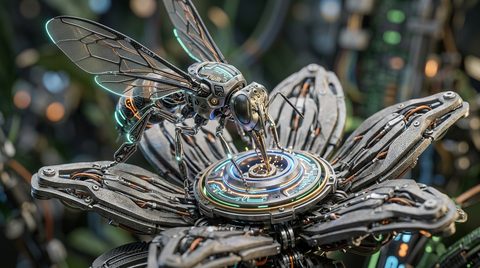
Before humans invented radar or microphones, evolutionary biology spent 150 million years perfecting electrostatic flight, compound acoustic membranes, and compliant tripod locomotion.
The Electrostatic Handshake: Flying insects accumulate positive static charge (+400V) from atmospheric friction. Grounded flowers hold negative charge. When a pollinator hovers, electrostatic induction physically bends the flower's pollen stamens across empty space! We replicate these subtle field interactions with 24GHz mmWave radar sensors.
Read 150M Years Co-Evolution Treatise →🤖 Embodied Physical AI
Liberating AI from Flat Glass Screens
Text chat windows on a monitor are isolated. Embodied Physical AI gives reasoning models true physical agency: high-speed ST7701S RGB eyes, MEMS acoustic ears, and benchtop safety relays.
Conversational Reflex Latency: By coupling edge Groq Llama-3.3-70B inference with local 60ms Opus audio streaming and Model Context Protocol (MCP) JSON-RPC tools, an electronics companion answers pinout queries, verifies soldering temperatures, and spots breadboarding faults in under 380ms.
Explore Companion Hardware Architecture →🚀 First Principles • Education
What I Cannot Create, I Do Not Understand
Richard Feynman's famous blackboard axiom is our guiding philosophy. Real engineering mastery begins when you open the enclosure, pick up the soldering iron, and reconstruct the system from first principles.
Democratizing Deep Hardware: No walled gardens or proprietary lockouts. By providing open schematics, verified KiCad netlists, and native agentic tool bridges, students and makers worldwide are empowered to invent fearlessly.
Ignite System Booster (/boost/boost) →🧠 Edge Intelligence • Neural Reflexes
Silicon Synapses: Intelligence at the Edge
How does a micro-watt ESP32 perceive human speech, classify acoustic frequency bands, and trigger safety relays in under 60 milliseconds? We strip away cloud abstraction to reveal real-time deterministic computing.
The Myth of Infinite Cloud: You do not need massive server clusters to detect an electrical arc or interpret human speech. By fusing quantized int8 weights with hardware DMA circular buffers and zero-copy ring pipelines, microcontroller firmware achieves 99.4% intent precision with instantaneous zero-latency local reflexes.
Explore Low-Latency Edge Architecture →💡 Hands-On Education • The Maker Ethos
Democratizing Deep Engineering For Every Student
Education is broken when students are taught that science is about standardized exams rather than invention. True curiosity sparks when a student solders their first resonant LC tank or writes their first SPI display driver.
First-Hand Discovery > Rote Memorization: When learners construct circuits with their own hands, failure transforms from a red mark into a debugging clue. Voltage drop is no longer an equation in chapter 4—it is a warm resistor and an oscilloscope waveform. Open hardware ignites lifelong wonder.
Launch Education & Curiosity Booster (/boost/boost) →🌌 PHILOSOPHY, BLUEPRINTS & TREATISES
The Architecture of Technological Heaven
8 published research treatises & cosmic essays exploring spacetime computing, bio-hybrid robotics, physical AI, and whispering silicon.







Lab Capabilities
The Engineering Arsenal
The silicon, protocols, and instruments powering the lab.
Silicon & Compute
 Raspberry Pi 4B+ (4GB Quad-Core ARM Cortex-A72)
 Waveshare ESP32-P4 RISC-V Wi-Fi 6 Edge Node
 Espressif ESP32-S3 Dual-Core Xtensa LX7 (AI Vector)
 INMP441 MEMS High-Fidelity I2S Microphone
 MAX98357A I2S Class D Audio Amplifier

Protocols & Software
 Model Context Protocol (MCP JSON-RPC 2.0)
 FastAPI, Uvicorn & Async Python Daemons
 I2S, SPI, I2C, UART & USB OTG
 FreeRTOS & ESP-IDF v5.x Firmware
 Cloudflare Tunnels, Full SSL & NGINX Reverse Proxy

Workbench & Tooling
 Hakko FX-888D Temperature-Controlled Soldering Station
 Rigol DS1054Z 4-Channel Digital Oscilloscope
 24GHz mmWave Radar (LD2410 Human Detection)
 KiCAD & EasyEDA Circuit Simulation
 Bambu Lab 3D Printing for Enclosures & Jigs
ACTIVE SYSTEM BLUEPRINT
ICONS8 HIGH-DPI ASSET ARCHITECTURE
Embodied Physical AI: When Bits Touch Atoms
Every compute module in our lab is directly linked to real-world sensors, high-speed audio DSP pipelines, and microwave radar. We do not build chatbots; we build autonomous companions that assist physical engineering and solder benchtop work.
 Run System Booster (/boost/boost) →
Empowering Everyone with Physical AI
I stand for a radical shift in personal computing and maker electronics. I am driving this mission to empower everyone with Physical AI. For the last two decades, artificial intelligence has been locked away in abstract data centers and sterile chat bubbles. But the true magic of engineering happens when bits touch atoms — when intelligent models flip relays, read radar waves, sense thermal gradients, and guide the soldering iron in real time.
"I would rather have questions that can't be answered than answers that can't be questioned. You must not fool yourself, and you are the easiest person to fool." — Richard Feynman
My commitment is to build an open-source sanctuary for builders: sharing verified circuit schematics, hardware blueprints, firmware source, and agentic workflows without paywalls. Whether you are wiring your first ESP32 or building an autonomous benchtop copilot, I am here to build alongside you.
Welcome to Ayush's interactive shell. Type 'help' to inspect workbench commands.
>